Body Mass Index (BMI)
Body Mass Index (BMI)
BMI is generally regarded as the easiest and most credible method currently available for calculating your body fatness, as well as classifying body fatness into standard weight categories. In fact, most health experts, and nearly all health agencies, like the CDC (Center for Disease Control and Prevention), use the BMI as the “Gold Standard” for accessing body fatness.
BMI does not measure body fat directly, but instead, uses a formula to calculate your body fatness as a number, based on your height and weight. The other methods used to measure body fat directly are much more difficult to conduct, and more expensive, they include -- skinfold thickness measurements (with calipers), underwater weighing, bioelectrical impedance, dual- energy x-ray absorptiometry (DXA), and isotope dilution.
BMI is calculated the same way for men, women, and children. The calculation is based on the following formula: weight (Ibs) / [height (in)] squared x 703
That is — BMI is calculated by dividing weight in pounds by height in inches, squared, and multiplying by a factor of 703.
Example: 135 lbs weight, 69 in height (5°9”)
Calculation: 135/(69 x 69 =4,761) x 703 = 19.93
Standard Weight Categories have been established by dividing the BMI numbers into four ranges, as shown below —
| BMI | Weight Category |
| Below 18.5 | Underweight |
| 18.5 to 24.9 | Normal or Healthy Weight |
| 25.0 to 29.9 | Overweight |
| 30.0 and Above | Obesity |
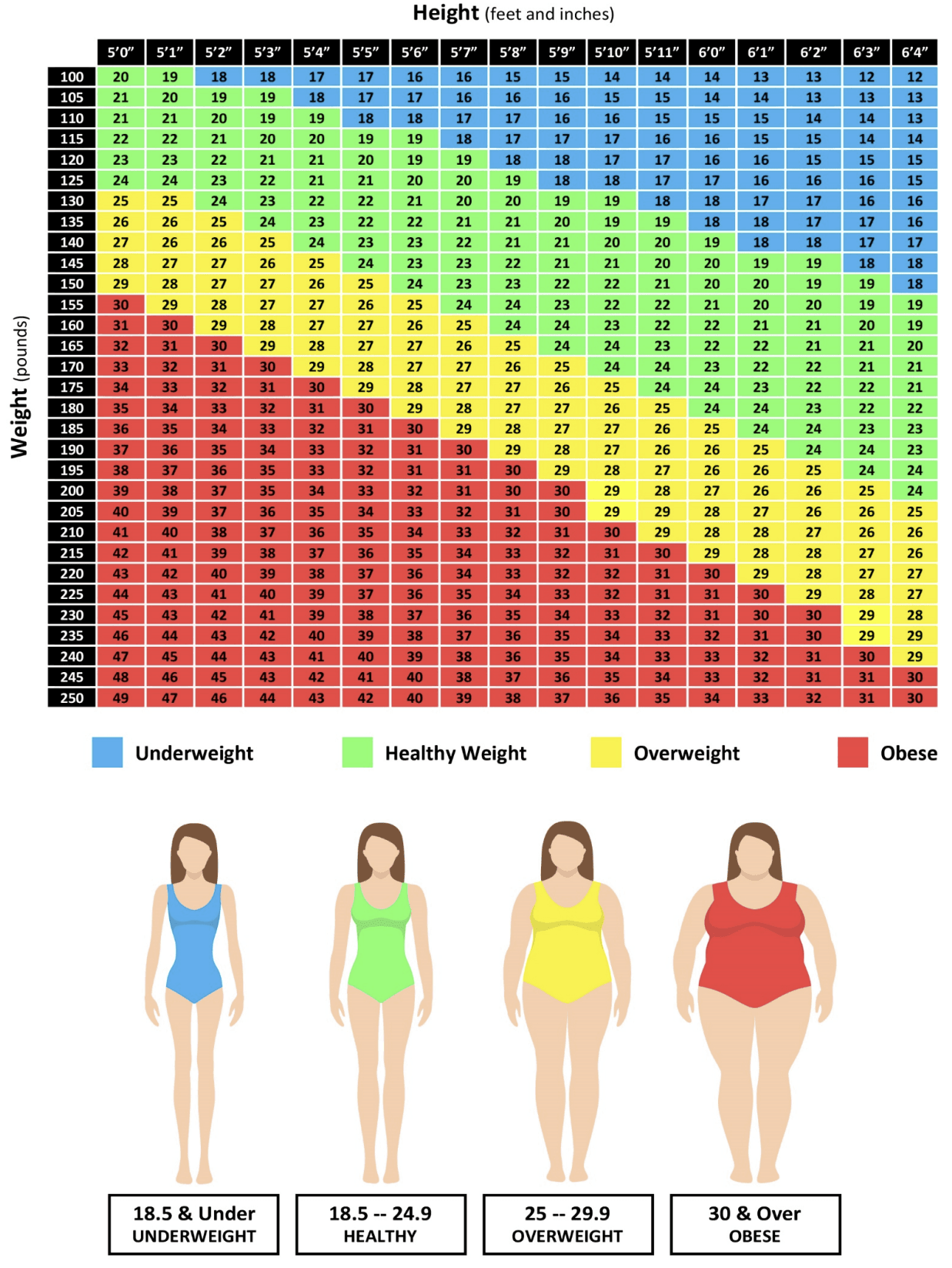
Although the above BMI calculation is fairly simple to do and is exact, there is even a simpler and more graphic way to determine your BMI number, by using one of the many BMI Charts that are available, like the one below.
Directions: To get your BMI from the chart, all you need to do is find your weight at the left, and your height at the top. Then, going right from your weight, and going down from your height, find your BMI number where the two columns intersect.
Body Mass Index (BMI)