Exercise
Exercise
Introduction
The underlying cause of Obesity and Overweight is two-fold —Overeating
Sedentary Lifestyle
The key to weight loss is understanding the Principle of Energy Balance —
Energy Input — How much you eat.
Energy Output — How much you move (exercise).
Ultimately, for optimum weight control, and overall health, you need to harness both parts of the energy balance equation. Think of it as an “energy balance one-two-punch.” To maximize weight control, you need to do two things simultaneously —
Diet — Eat fewer calories
Exercise — Burn more calories
There’s a wonderful ‘synergy’ that comes into play between diet and exercise. Once you start to eat right to lose weight, you will naturally want to start exercising right to lose weight. In other words, the more you do one, the more you will want to do the other, and vice versa.
Aerobic Exercise
The term aerobic means “with oxygen.” Aerobic Exercise, sometimes called Endurance Exercise or Cardiorespiratory Exercise, or just Cardio, strengthens and conditions your heart and lungs. It gets your heart pumping and your lungs breathing, by engaging the large muscles of your lower body.Benefits of Aerobic Exercise
Here are some of the many health benefits derived from Aerobic Exercise —- Improves Cardiorespiratory Health
- Lowers Blood Pressure
- Regulates Blood Sugar
- Regulates Body Weight
- Strengthens Immune System
- Improves Brain Function
- Reduces Stress, Anxiety, and Depression
- Improves Mood
- Improves Sleep
- But the most important health benefit derived from Aerobic Exercise, that encompasses nearly all of the benefits listed above, is this —
- Improves Metabolic Function
Aerobic Exercise and Metabolic Function
Regular aerobic exercise is the key to optimum human metabolic function, and it plays a major role in weight control, overall health, and longevity.
The best way to explain the importance of metabolic function is to draw an ‘analogy.’
‘We all know that an engine is what powers a car, and in order to run properly, an engine needs to be tuned up. An engine that isn’t tuned up will run badly, perform poorly, and it may even stall-out and die. On the other hand, an engine that is properly tuned up will run smoothly, perform well, it will be very reliable, and it will last a long time. In a similar way, our metabolism is the engine that powers our bodies, and in order to run properly, our metabolism needs to be tuned up as well. Regular aerobic exercise is how we tune up our metabolism. If we don’t engage in regular aerobic exercise, our metabolic engine gets out of tune, and it begins to run badly — insulin resistance is triggered — and this leads to fat storage, weight gain, obesity, and major health problems.
There is now overwhelming scientific evidence that 20 of the 21 metabolic conditions associated with Obesity, Heart Disease, and Cancer, are significantly improved through regular aerobic exercise —
| Published Scientific Validation That Condition is Improved Through | |
| Metabolic Condition | Regular Aerobic Exercise |
| Obesity - | |
1. Insulin Resistance | Yes |
2. Blood Sugar Levels | Yes |
3. Muscle Oxygen Utilization | Yes |
4. Basal Metabolic Rate | Yes |
5. Metabolizing Body Fat | Yes |
6. Fat Metabolizing Enzymes | Yes |
| Heart Disease— | |
7. Strengthening The Heart | Yes |
8. LDL Cholesterol Levels | Yes |
9. HDL Cholesterol Levels | Yes |
10. LDL Cholesterol Oxidation | Yes |
11. High Blood Pressure | Yes |
| Blood Clotting Risk Factors: | |
13. Platelet Adhesiveness | Yes |
14. Lipoprotein(a) Levels | Yes |
15. Homocysteine Levels | Yes |
16. Triglyceride Levels | Yes |
17. Fibrinogen Levels | Yes |
18. Blood Viscosity | Yes |
| Cancer – | |
19. Immune System Function | Yes |
20. Cell DNA Condition | --- |
21. Types of Cancer Affected: Breast, Colon, and Prostate | Yes |
Tuning Up Your Metabolic Engine
We made the analogy that our metabolism is the engine that powers our bodies, and that regular aerobic exercise keeps our metabolic engine tuned up and running properly. So the question is — How much aerobic exercise is needed to “tune up” your metabolic engine?
Aerobic exercise needs to engage the large muscles of your lower body to work your heart (cardio) and lungs (respiratory) hard enough and long enough to produce what is called the — training effect — which leads to aerobic conditioning or fitness, and most importantly, which leads to a “tune up” of your metabolic engine.
The training effect is achieved by applying the “FIT” acronym, which stands for — Frequency, Intensity, and Time. To produce a good training effect, you must exercise often enough (Frequency), hard enough (Intensity), and long enough (Time). Based on our research, our recommendation for how much aerobic exercise is needed to produce an excellent training effect, and how much is needed to fully “tune up” your metabolic engine is as follows —
Frequency — How many times per week.
Getting Started — 3 to 4 times per week.
Recommended Target — 6 times per week.
Time (Duration) — How long or how many minutes.
Getting Sarted — 15 to 20 minutes.
Recommended Target — 30 minutes.
Intensity
The intensity of your aerobic exercise workout refers to how hard you are working, and hence, how fast your heart is beating. All available research and data indicates that to produce a training effect, and to achieve a metabolic tune up, you need to exercise at 50% to 80% of your maximum heart rate. This range is referred to as your Target Heart Rate Zone.
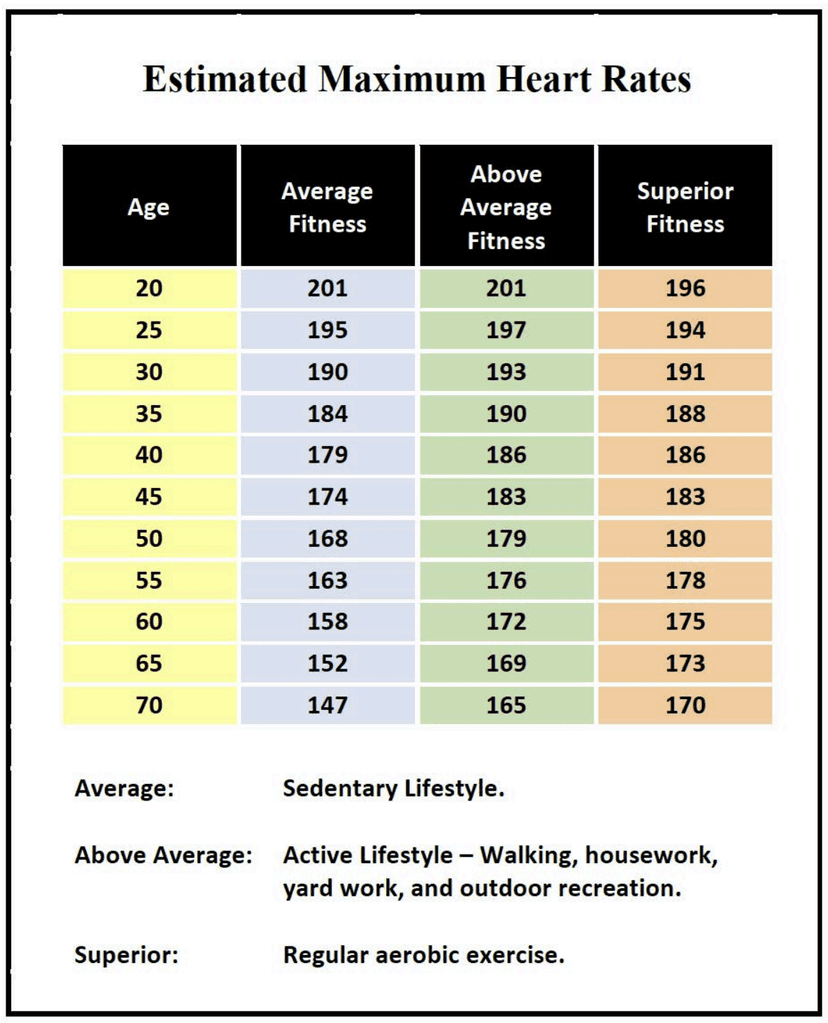
To determine your Zone, start by finding your maximum heart rate, using the chart below entitled — Estimated Maximum Heart Rates. Simply locate your age, to the nearest five years, in the left hand column, then locate your fitness level column, based on the descriptions at the bottom. The number indicated is your estimated maximum heart rate.
How to Calculate Your Target Heart Rate Zone
To calculate your Target Heart Rate Zone, use the following example —If you are 50 years old, with average fitness, you would have a maximum heart rate of — 168
50% -- 168 x .50 = 84 Heart Rate
80% -- 168 x .80 = 134 Heart Rate
Your Target Heart Rate Zone would be —
84 to 134 Heart Rate
How to Determine Your Heart Rate
There are two primary methods used to determine your heart rate level — Actual Heart Rate — This is an objective measure that is determined in one of two ways.
Take your own pulse — which can be difficult to do.
Use a Heart Rate Monitor — this would be our recommendation, because they are accurate, easy to use, and affordable.
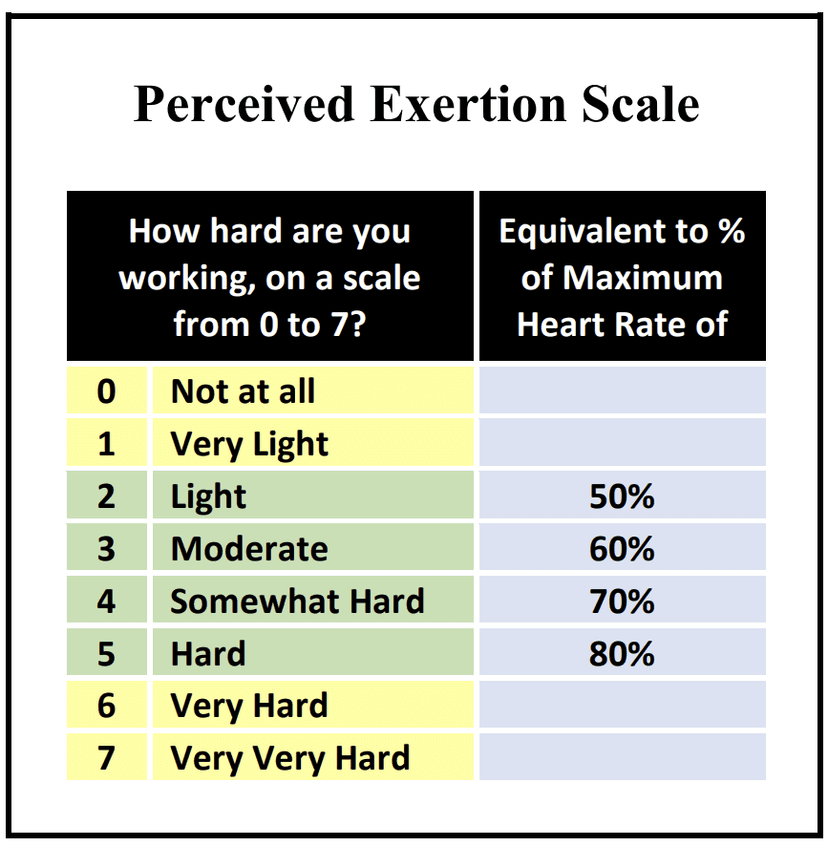
Perceived Exertion — This is a subjective measure of how hard you are working, based on how you feel — how out of breath you are, or how much you are sweating. (SEE the Perceived Exertion Scale below.)